For the past decade, critical mineral analysts modeled global rare-earth magnet demand around two primary industrial drivers: electric vehicle (EV) traction motors and offshore wind turbines. Today, a third industrial consumer is emerging that is far more magnet-intensive per unit than an automobile: bipedal humanoid robots.
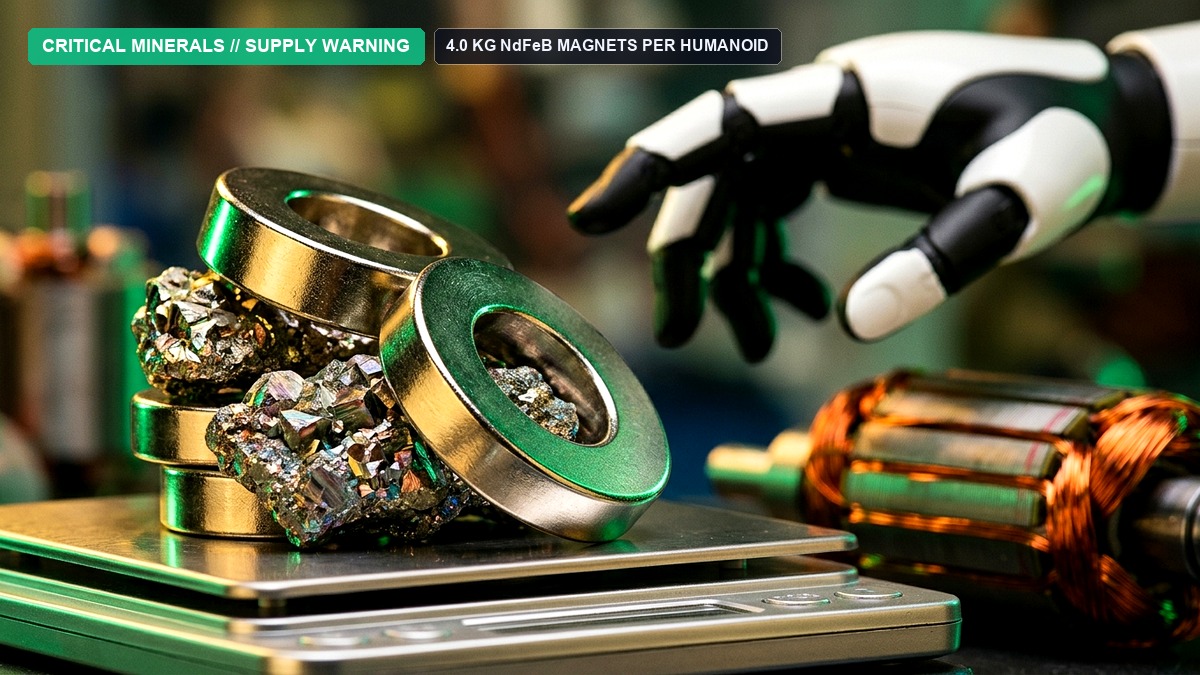
According to a comprehensive engineering tear-down and commodity forecast published this week by Argus Media, every commercial-grade humanoid robot entering factory production requires between 3.5 kilograms and 4.2 kilograms of high-grade sintered neodymium-iron-boron (NdFeB) permanent magnets — roughly double the 1.8 kg to 2.2 kg used in a typical battery-electric passenger car.
Why Humanoid Joints Devour Heavy Rare Earths
Unlike an electric car, which relies on one or two large liquid-cooled drive motors, a humanoid robot such as Tesla’s Optimus Gen 3, Figure 03, or Apptronik’s Apollo packs 28 to 44 distinct rotary and linear actuators into its shoulders, elbows, wrists, hips, knees, ankles, and dexterous 22-degree-of-freedom hands.
- A landmark supply-chain study by Argus Media finds that a single full-scale bipedal humanoid robot requires 3.5 kg to 4.2 kg of sintered NdFeB rare-earth permanent magnets — nearly double the amount inside a standard electric vehicle traction motor.
- Because humanoid rotary and linear actuators operate inside compact, thermally constrained limbs without liquid cooling, their magnets require heavy doping with dysprosium (Dy) and terbium (Tb) to prevent demagnetization.
- Even modest global production of 500,000 humanoid robots annually by late 2027 will tip the global heavy rare-earth market into a structural 1,800-metric-ton deficit.
“Everyone is counting GPUs for training robot brains, but nobody is counting the 4 kilograms of dysprosium-doped rare-earth magnets required to make each robot stand up and walk.”—
- ✓Sources: written from primary sources and official statements, linked above.
- ✓Fact-check: names, dates and claims checked against the original sources.
- ✓AI use: researched with AI tools; written and reviewed by our editors. Our AI policy
- ✓Independence: UpdateNext has no financial relationship with the companies covered.