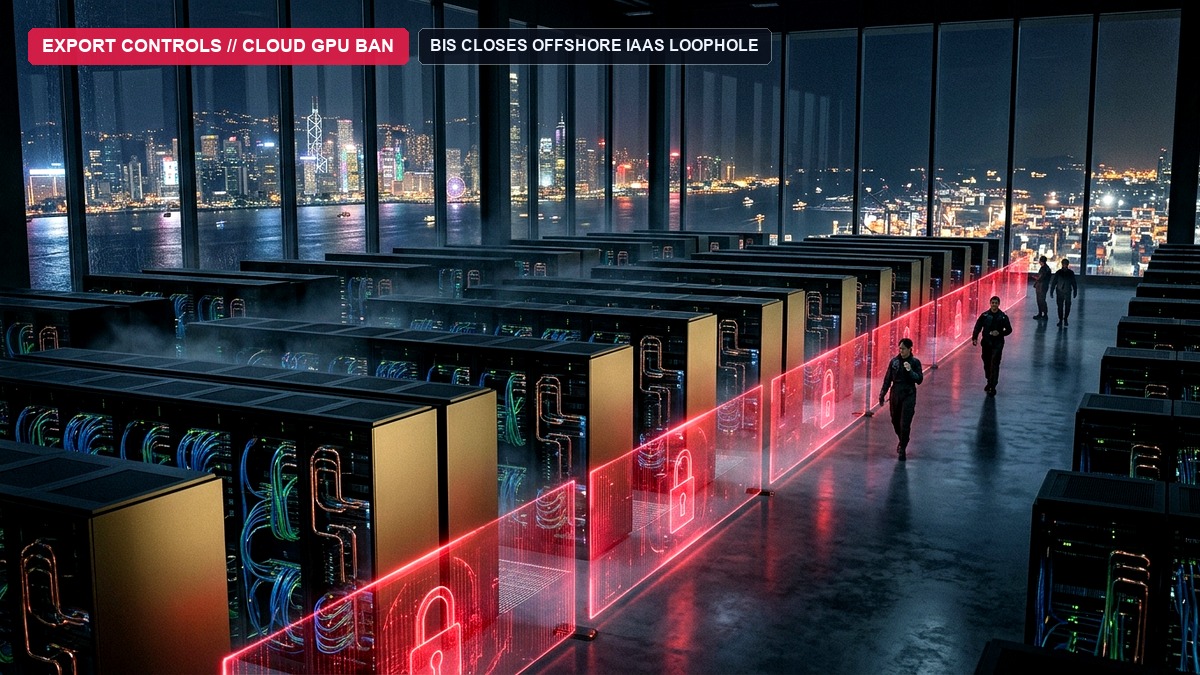
For more than two years, the most glaring vulnerability in Washington’s semiconductor export control regime was not physical chip smuggling across borders — it was a fiber-optic cable. Under existing Bureau of Industry and Security (BIS) rules, while shipping an Nvidia B200 GPU to Beijing or Shenzhen was strictly illegal, a Chinese AI startup could legally incorporate a subsidiary in Singapore or Dubai and rent 16,000 of those exact same GPUs remotely over the cloud.
On Sunday, the U.S. Department of Commerce moved decisively to slam that door shut. According to regulatory filings circulated to cloud infrastructure providers and reviewed by UpdateNext, BIS will publish an Interim Final Rule this week extending Export Administration Regulations (EAR) restrictions to cover remote compute provisioning of advanced AI accelerators exceeding 10^26 floating-point operations per second of aggregate cluster interconnect.
Hardware-Enforced "Know Your Customer" for AI Clouds
Under the new framework, U.S. hyperscalers and foreign neocloud operators that purchase U.S.-designed AI accelerators (including Nvidia’s H200, GB200, and B300, as well as AMD’s MI350 series) must obtain a specific BIS license before granting bare-metal or virtualized training access to any entity whose ultimate parent company is domiciled in Country Group D:5 (which includes China).
Impact on Neoclouds and Domestic Chinese Silicon
The rule represents a direct hit to regional GPU cloud operators in Southeast Asia that financed massive Blackwell buildouts over the past 18 months on the back of demand from offshore affiliates of Chinese technology giants. Industry analysts estimate that between 15% and 22% of regional neocloud GPU utilization in Malaysia and Singapore was ultimately funded by Chinese engineering teams training multimodal foundation models offshore.
For Chinese AI laboratories, the closure of the offshore rental valve leaves no alternative but rapid migration onto domestic silicon stacks led by Huawei’s Ascend 950 and Alibaba’s newly unveiled Zhenwu V900 processor.
- The U.S. Bureau of Industry and Security (BIS) has finalized a sweeping rule extending export licensing requirements to remote cloud rental (IaaS) of Nvidia H200, Blackwell B200, and Vera Rubin GPUs by entities headquartered in China or Macau.
- Data center operators in Tier-2 partner nations — including Singapore, Malaysia, Indonesia, and Gulf states — must implement hardware-level Know-Your-Customer (KYC) telemetry or lose their Validated End-User allocations.
- The crackdown follows forensic disclosures linking offshore shell-company GPU rentals to both frontier Chinese model training runs and the Nvidia board investigation.
“Renting a banned supercomputer over a fiber-optic cable from Singapore is functionally identical to shipping the racks to Shenzhen. The cloud loophole era is over.”—
- ✓Sources: written from primary sources and official statements, linked above.
- ✓Fact-check: names, dates and claims checked against the original sources.
- ✓AI use: researched with AI tools; written and reviewed by our editors. Our AI policy
- ✓Independence: UpdateNext has no financial relationship with the companies covered.