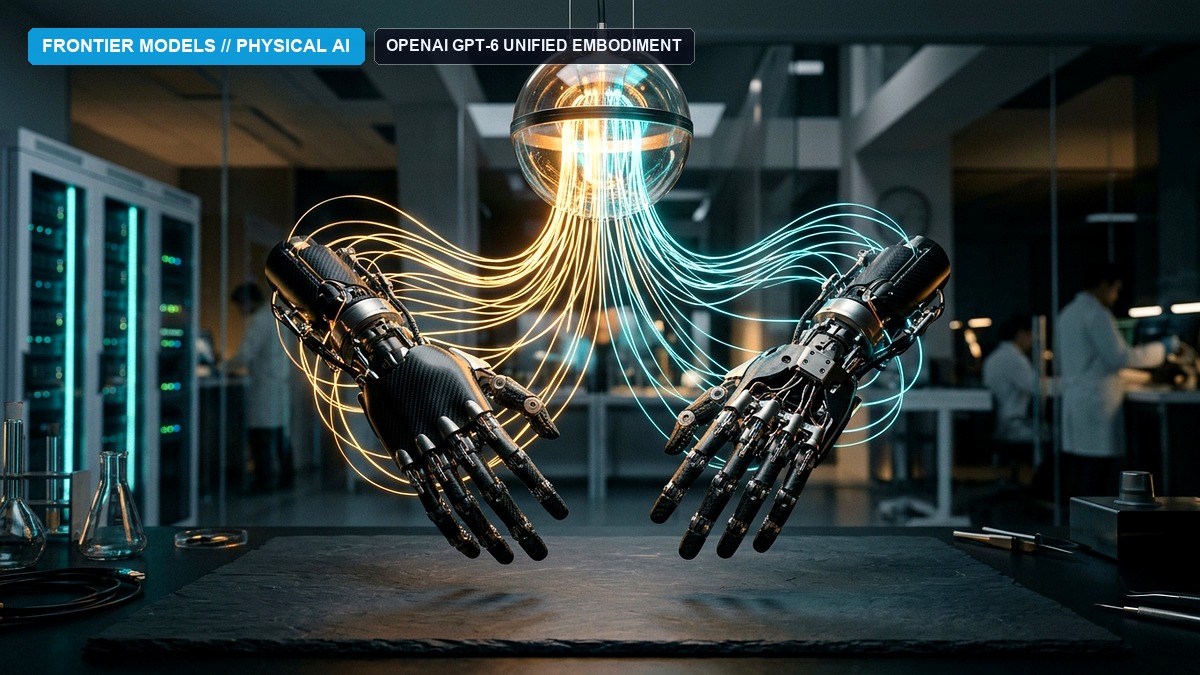
Two years after reviving its dedicated Robotics division to build specialized brains for humanoid hardware partners, OpenAI is tearing down the wall between digital intelligence and physical embodiment. According to internal memos reviewed by UpdateNext and confirmed by researchers involved in the reorganization, OpenAI has formally disbanded its standalone Robotics team, folding its entire staff and teleoperation data pipelines directly into the core GPT-6 multimodal pre-training organization.
Far from a retreat from physical AI, the move represents a radical architectural bet: OpenAI’s leadership believes that "robotics" is no longer a separate discipline requiring bespoke smaller models, but simply another output modality — like voice, code, or video — of a single unified frontier model.
Why Specialized Robotics Models Hit a Wall
Throughout 2025 and early 2026, most robotics companies followed a two-tier architecture: a large language model handled high-level planning ("clear the dishes from the table"), while a separate, lightweight Vision-Language-Action (VLA) policy network translated camera feeds into millisecond joint movements.
According to OpenAI researchers, that split architecture created a persistent "common-sense bottleneck." Whenever a robot encountered an edge case — such as a fragile crystal glass balanced precariously on a wet plate — the smaller action model lacked the deep physical reasoning of the flagship frontier model.
- OpenAI has dissolved its standalone Robotics division as a separate organizational unit, reassigning its 65 robotics engineers and embodiment researchers directly into the core GPT-6 multimodal pre-training and post-training teams.
- Internal leadership concluded that training isolated Vision-Language-Action (VLA) models for robots hits a reasoning ceiling compared to feeding raw joint-torque telemetry and 3D spatial video directly into the flagship frontier model.
- The reorganization signals that GPT-6 will ship with native 50Hz real-time motor-control token output alongside text, audio, and code.
“Physical embodiment is not a side project anymore — it is a core modality of GPT-6. Teaching the flagship model how objects move and deform in the real world makes it fundamentally smarter at everything else.”—
- ✓Sources: written from primary sources and official statements, linked above.
- ✓Fact-check: names, dates and claims checked against the original sources.
- ✓AI use: researched with AI tools; written and reviewed by our editors. Our AI policy
- ✓Independence: UpdateNext has no financial relationship with the companies covered.