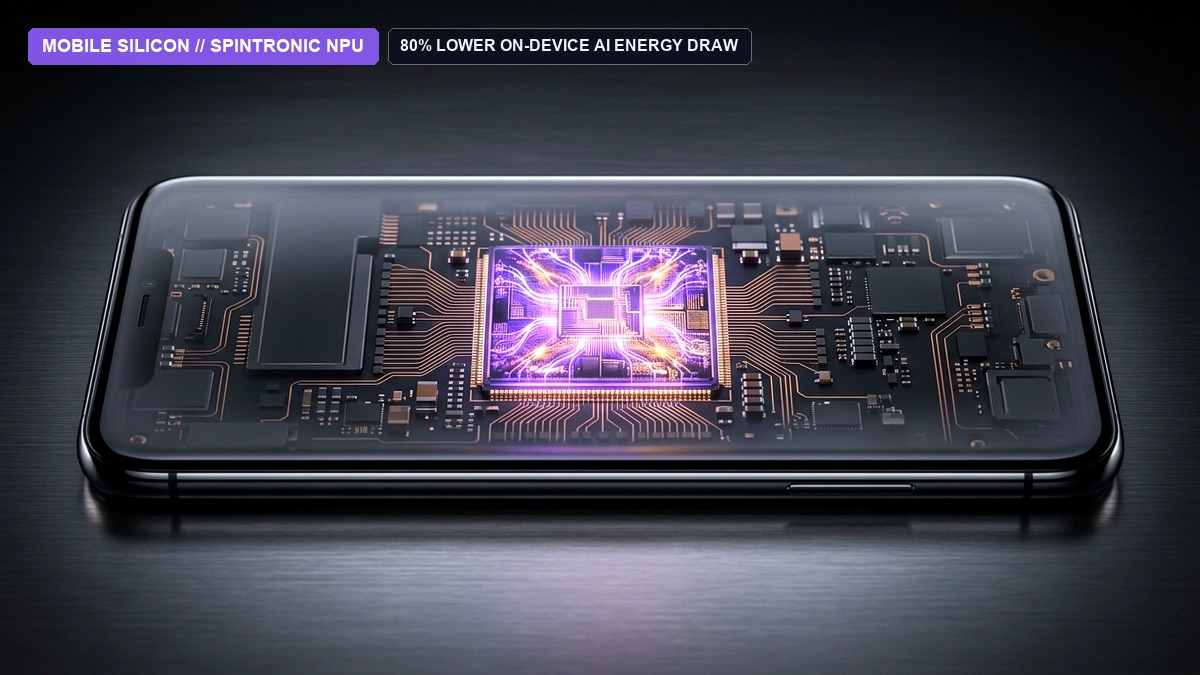
Every smartphone user who has tried running an on-device generative AI assistant, real-time voice translator, or local image generator knows the dirty secret of mobile AI: within ten minutes, the back of the phone grows uncomfortably hot and the battery percentage visibly plunges. Even on cutting-edge 2-nanometer silicon, pushing billions of model weights back and forth between LPDDR5X memory and a Neural Processing Unit (NPU) burns watts of energy as waste heat.
Now, a landmark breakthrough in nanoscale spintronics promises to shatter the mobile energy wall. In research demonstrated on 300mm foundry test wafers this week, a consortium of applied physicists and semiconductor device engineers unveiled a room-temperature topological spin-orbit torque (SOT) tensor array that slashes the energy required for AI matrix multiplication by 80% to 84% compared to conventional CMOS logic.
Computing with Magnetic Spin Instead of Electric Charge
- Semiconductor researchers have demonstrated the first CMOS-compatible, room-temperature nanoscale magnetic spin-wave (spintronic) tensor array capable of executing LLM matrix multiplications at 80% lower energy than 2nm silicon transistors.
- Unlike conventional chips that waste massive heat shuttling electrical charges between DRAM and the NPU, spintronic memory-compute cells flip magnetic electron spins in-place with near-zero standby leakage.
- Mobile SoC architects at Qualcomm, MediaTek, and Apple are already evaluating hybrid spintronic NPU chiplets for 2028–2029 flagship smartphones.
“By flipping electron spins in-place rather than shuttling electrical charges across copper wires, we eliminate 80% of the heat and battery drain of on-device AI.”—
- ✓Sources: written from primary sources and official statements, linked above.
- ✓Fact-check: names, dates and claims checked against the original sources.
- ✓AI use: researched with AI tools; written and reviewed by our editors. Our AI policy
- ✓Independence: UpdateNext has no financial relationship with the companies covered.