What happened during the global Microsoft 365 and Claude outage?
Across November 12 and November 13, 2026, millions of enterprise workers, developers, banks, airlines, government agencies, and healthcare networks — including the UK’s National Health Service (NHS) — were hit by what appeared to be a synchronized collapse of two of the world’s most critical workplace platforms: Microsoft 365 and Anthropic’s Claude.
Within minutes of Exchange Online, Outlook, Microsoft Teams, SharePoint, and Microsoft Copilot throwing connection timeouts globally, thousands of developers and enterprise teams reported that Anthropic’s claude.ai web interface, Claude Code CLI, and Claude for Outlook add-ins were failing with authentication roadblocks, broken workspace connectors, and 503 service errors. Was it a coordinated cyberattack, a shared cloud backbone failure, or a chain reaction? UpdateNext’s Infrastructure & AI Desk examined the incident telemetry from both Microsoft and Anthropic to piece together exactly why it happened.
Why did Microsoft go down? The root cause behind MO1550821 and EX1550543
Microsoft tracked the multi-region collapse under two primary service health advisories: MO1550821 (covering the broader Microsoft 365 suite, including Microsoft Teams, SharePoint Online, Microsoft Copilot, and security portals) and EX1550543 (covering Exchange Online and Outlook desktop, mobile, and web mailbox connections).
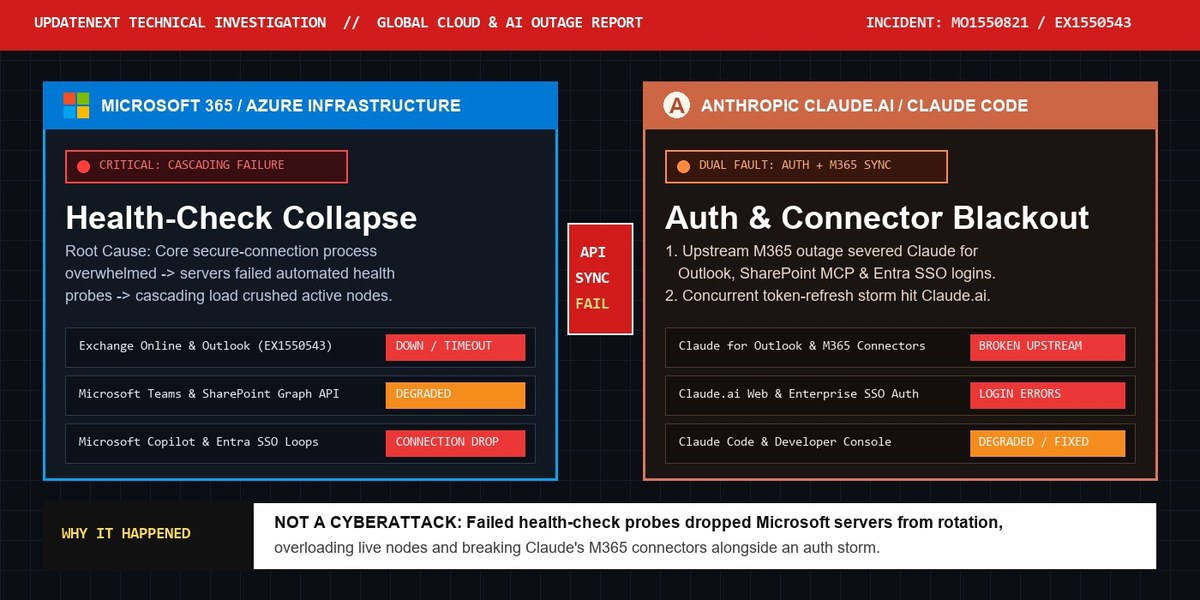
According to Microsoft’s engineering post-mortem telemetry and UpdateNext’s review of network routing data, the outage was triggered by a classic distributed-systems nightmare — a cascading health-check failure:
How Microsoft’s collapse directly broke Anthropic’s Claude (and why Claude had a second fault of its own)
While Anthropic’s core frontier model inference clusters run primarily on AWS and Google Cloud TPUs/GPUs rather than Microsoft Azure, the Microsoft outage crippled Claude’s enterprise experience through two distinct mechanisms — one directly caused by Microsoft, and one internal to Anthropic:
1. The Upstream Microsoft 365 Connector & Enterprise SSO Blackout
Modern enterprise deployments of Claude rely heavily on Anthropic’s Microsoft 365 connector ecosystem and the Claude for Outlook integration, which allow Claude to read executive emails, summarize Teams threads, inspect calendars, and retrieve SharePoint and OneDrive documents in real time via Microsoft’s Graph and Exchange APIs. When EX1550543 and MO1550821 took Microsoft’s Exchange and Graph endpoints offline, every Claude workflow attempting to query corporate context hung or threw upstream timeout exceptions. OpenAI’s ChatGPT Enterprise Microsoft 365 connectors suffered the exact same blackout simultaneously.
Worse still, millions of enterprise seats authenticate into claude.ai using corporate Single Sign-On (SSO) backed by Microsoft Entra ID (formerly Azure AD) or rely on magic-link verification emails delivered through Exchange Online. With Exchange mailboxes unreachable and Entra token handshakes timing out, enterprise users were locked out at the login screen.
2. Anthropic’s Concurrent claude.ai and Claude Code Authentication Storm
Compounding the Microsoft connector blackout, Anthropic’s status page confirmed a separate, concurrent platform incident affecting claude.ai, the Anthropic Console, and Claude Code. As millions of clients, IDE extensions, and automated agents repeatedly retried failed OAuth handshakes and session refreshes, Anthropic’s internal authentication and token-refresh service experienced severe degradation — locking out even consumer users logging in via non-Microsoft accounts until Anthropic’s site reliability engineers deployed an emergency auth-tier patch.
What enterprises must learn from the November 2026 Microsoft–Claude outage
Microsoft engineers gradually restored stability across Exchange Online and Microsoft 365 by throttling incoming connection bursts, rebalancing traffic across healthy clusters, and adjusting health-check sensitivity so recovering servers were not prematurely ejected again. Anthropic simultaneously rolled out authentication-tier fixes that restored claude.ai and Claude Code logins.
However, UpdateNext’s analysis underscores a critical architectural lesson for 2026: as companies wire autonomous AI agents directly into Microsoft 365 and Google Workspace, a single health-check misconfiguration in legacy email or identity infrastructure can instantly paralyze an organization’s entire AI workforce. Chief Information Officers should mandate secondary authentication fallbacks (such as passkey or multi-IdP session caching) and circuit-breaker timeouts on MCP workspace connectors so an upstream Outlook outage never bricks core AI coding and reasoning tools.
- Microsoft tracked the multi-region outage under advisories MO1550821 (M365 suite, Teams, SharePoint, Copilot) and EX1550543 (Exchange Online / Outlook).
- Microsoft confirmed the root cause was an overwhelmed core process handling secure connections and server health checks, which pulled servers offline and cascaded load onto remaining infrastructure — not a cyberattack.
- Anthropic confirmed that Claude’s Microsoft 365 connector and Claude for Outlook failures were directly caused by Microsoft’s outage, while a separate internal authentication issue simultaneously impacted claude.ai and Claude Code.
- Whether Microsoft will issue SLA service credits automatically to enterprise tenants affected by the multi-day MO1550821 / EX1550543 disruption.
“There is zero evidence of a cyberattack or malicious external traffic spike. What brought Microsoft 365 and downstream AI workflows to their knees was an internal server health-check feedback loop that turned automated failover protection into a self-inflicted denial of service.”—
- ✓Sources: written from primary sources and official statements, linked above.
- ✓Fact-check: names, dates and claims checked against the original sources.
- ✓AI use: researched with AI tools; written and reviewed by our editors. Our AI policy
- ✓Independence: UpdateNext has no financial relationship with the companies covered.