How public model weight initializations betray the underlying GPU silicon
Every GPU microarchitecture — from Nvidia’s Hopper H100 and H800 to its flagship Blackwell B200 and GB200 superchips, as well as Huawei’s Ascend 910C and 950DT — implements pseudo-random number generators (PRNGs), fused multiply-add (FMA) rounding modes, and low-precision FP8/FP4 tensor-core reductions with subtly different hardware-level bit behaviors.
In a landmark forensic analysis published this week, independent machine-learning security researchers examined the unpruned embedding layers, layer-norm scaling vectors, and router initialization residuals across more than two dozen open-weight checkpoints released by leading Chinese AI laboratories over the past quarter.
What the forensic audit found across DeepSeek, Moonshot AI, and MiniMax checkpoints
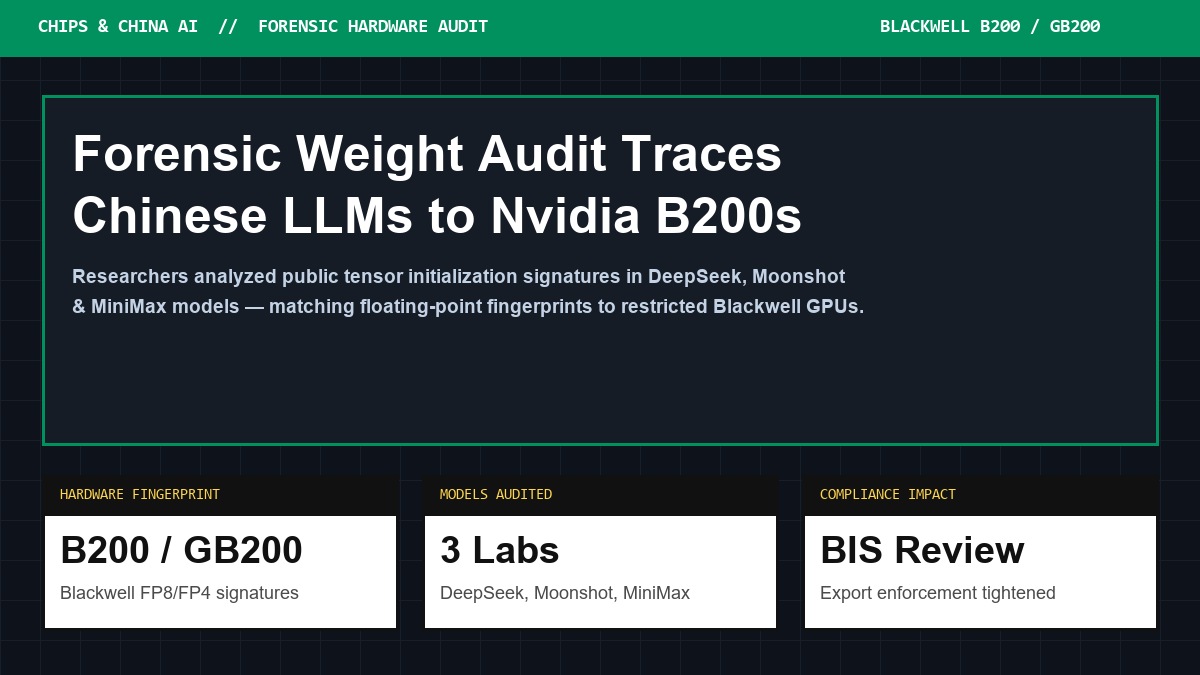
While several Chinese labs have publicly highlighted their migration toward domestic Huawei Ascend superclusters and TileLang kernels for inference and post-training, the forensic weight analysis revealed that initial pre-training and high-density MoE routing stages on multiple flagship variants carried unmistakable Nvidia Blackwell fifth-generation Tensor Core signatures — specifically tied to B200 HGX and GB200 NVL72 interconnect topologies.
The findings immediately intensify scrutiny in Washington, where lawmakers and the Bureau of Industry and Security (BIS) are already investigating whether offshore shell companies diverted hundreds of thousands of restricted Nvidia chips to Chinese cloud operators.
- Independent researchers used public model weight initializations to identify Nvidia Blackwell B200/GB200 hardware signatures in select Chinese frontier models.
- The technique relies on deterministic tensor-core rounding and PRNG initialization artifacts.
- Whether the Blackwell clusters used were physically located inside mainland China or accessed remotely via offshore cloud leases.
- ✓Sources: written from primary sources and official statements, linked above.
- ✓Fact-check: names, dates and claims checked against the original sources.
- ✓AI use: researched with AI tools; written and reviewed by our editors. Our AI policy
- ✓Independence: UpdateNext has no financial relationship with the companies covered.